
Abstract:
Starting with the consideration that massive multiplayer online gaming (MMOG) is a latency-critical representative of the class of highly interactive multi-user multimedia applications, we have acquired trace data from an MMOG operator and investigated the features of this traffic. Approaching latency from several angles, we found two quite different improvements that can improve a variety of interactive applications.
The first is based on the understanding that reliable transport protocols such as TCP and SCTP are basically suited for a class of interactive traffic that generates thin streams, but that some modifications are required. These thin-stream modifications work nicely with regular applications and unmodified receivers, but produce easily noticable improvements for thin-stream applications such as games, remote login, voice-over-IP, and the like.
The second is based on an observation that games and many other distributed virtual environments are divided in areas-of-interest, and that avatars‘ locations in such areas define frequently changing all-to-all overlay multicast groups. Considering that IP multicast is not generally available, we have investigated how such multicast groups within a larger distributed application should be maintained and updated. Depending on application parameters, the appropriate decisions differ quite widely, and we have explored a large part of the parameter space.
Biographie:
Carsten Griwodz leads the Media Performance Group at the Norwegian research company Simula Research Laboratory AS, Norway, and is Professor at the University of Oslo. He received his Diploma in Computer Science from the University of Paderborn, Germany, in 1993. From 1993 to 1997, he worked at the IBM European Networking Center in Heidelberg, Germany. In 1997 he joined the Multimedia Communications Lab at Darmstadt University of Technology, Germany, where he obtained his doctoral degree in 2000. His interests lie in the improvement of system support for interactive distributed multimedia, with heterogeneous parallel processing, operating systems and protocol support for streaming applications and multiplayer games in particular. He leads the StorIKT project Verdione that investigates system support for the World Opera, and is member of the Center for Research-based Innovation „Information Access Disruptions“ that develops next generation search technology.


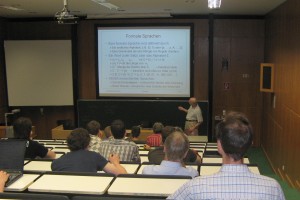 In der Vortragsreihe des Projektes Informatik verstehen hat am 8. Juni Herr Prof. Böszörmenyi vom Institut für Informationstechnologie über das Thema „Die unsichtbaren Diener – Der Compiler und seine Artgenossen“ referiert. Neben Mitarbeitern der Universität nahmen erfreulicherweise auch Lehrer und zahlreiche Schüler am Vortrag teil.
 Abstract:
 Hinter jeder Interaktion mit einem Computer liegt zumindest eine „formale Sprache“, egal, ob es sich dabei um klassische Programmierung oder zum Beispiel um eine Interaktion über eine graphische Schnittstelle handelt.
 Mit der Entwicklung der Informationstheorie gelang C. E. Shannon bereits im Jahre 1948 der Beweis, das mittels geeigneter Codierverfahren auch über gestörte Übertragungskanäle prinzipiell eine fehlerfreie digitale Übertragung möglich ist, solange nicht versucht wird, mehr Daten zu übertragen als die Kapazität des Kanals zulässt. Dieses Kanalcodierungstheorem leitete eine breite Forschungstätigkeit auf dem Gebiet der Kanalcodierung ein. Dennoch wurden über viele Jahre trotz des Einsatzes anspruchsvollster mathematischer Methoden nur eher bescheidene Fortschritte erreicht und das Ziel, die informationstheoretische Kapazität von Übertragungskanälen in der Praxis nutzbar zu machen, erschien grundsätzlich unerreichbar. Erst durch die Zufallserfindung der sog. „Turbo-Codes