
Die Studienreise zum IBM-Forschungszentrum Rüschlikon muss leider aufgrund der geringen Teilnehmeranzahl auf das Frühjahr 2010 verschoben werden. Als neuen Termin peilen wir den 22.-24. April 2010 an und dieser ist auch schon im Fakultätskalender eingetragen. Also bitte gleich mal vormerken und/oder unverbindlich via Facebook zumelden 😉
TEWI-High-Performer ausgezeichnet und Förderpreis der Technischen Fakultät vergeben
25. Oktober 2009
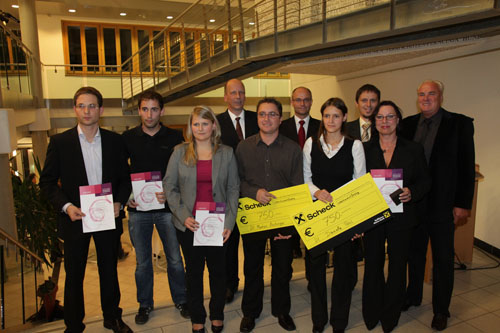 Im Rahmen der Eröffnung des akademischen Jahres 2010/2011 hat der Förderverein Technische Fakultät die TEWI-High-Performer, als Co-Sponsor gemeinsam mit IBM, ausgezeichnet und den Förderpreis der Technischen Fakultät vergeben.
In Anerkennung für ihre Leistungen aus dem vergangenen Studienjahr, wurden die »Best Performers« der vier Studienrichtungen der Technischen Fakultät an der Universität Klagenfurt mit, einem von IBM und dem Förderverein Technische Fakultät gestifteten Preis, ausgezeichnet, wobei ECTS und Noten aller Beurteilungen berücksichtigt wurden. Je EUR 500,– und eine Universitätsnadel in Silber erhielten

- Robert Göritzer* (Bachelor-Studium Informatik, 283 Punkte)
- Günther Repitsch (Bachelor-Studium Informationsmanagement, 326 Punkte)
- Evamaria Ruß (Bachelor-Studium Technische Mathematik, 365 Punkte)
- Christoph Unterrieder (Bachelor-Studium Informationstechnik, 245 Punkte)
Der diesjährige Förderpreis der Technischen Fakultät (gestiftet vom Förderverein Technische Fakultät) für die beste Diplom- bzw. Magisterarbeit aller Studien der Technischen Fakultät an der Universität Klagenfurt erhielten Frau DI Daniela Pohl (»Specification Comprehension – Konzeptverwaltung am Beispiel zustandsbasierter Spezifikationen«) und Herr DI Markus Aschinger** (»Constraint-based Composition of Recommendations«). Sie wurden mit jeweils EUR 750,– ausgezeichnet.
Wir gratulieren recht herzlich!
* … befindet sich derzeit auf Praxissemester an der TU Delft. Preis wurde entgegen genommen von seinen Eltern.
** … ist nach Oxford gewechselt um dort an seiner Dissertation zu arbeiten. Preis wurde entgegen genommen von Andreas Griesser, langjähriger Bürokollege an der Universität Klagenfurt.
Posted in Studienabgänger, News Kommentare deaktiviert für TEWI-High-Performer ausgezeichnet und Förderpreis der Technischen Fakultät vergeben
Studienreise IBM-Forschungszentrum Rüschlikon noch Plätze frei!
22. Oktober 2009
Für unsere Studienreise zum IBM-Forschungszentrum Rüschlikon sind noch Plätze frei. Wir bitten um Anmeldung per E-Mail an Frau Klothilde Puschl (Klothilde.Puschl@uni-klu.ac.at) bis 30. Oktober. Genauere Informationen entnehmen Sie bitte hier.
Posted in Veranstaltungen, News Kommentare deaktiviert für Studienreise IBM-Forschungszentrum Rüschlikon noch Plätze frei!
Neue Webseite Förderverein Technische Fakultät
19. Oktober 2009
 Liebe Vereinsmitglieder,
mit dieser Nachricht möchte ich Sie recht herzlich auf unsere neue Webseite hinweisen:
http://www.foerderverein-technische-fakultaet.at/
Am Design selbst wurde wenig verändert, wohl aber an der Funktionalität, welche durch eine Reihe von „Web 2.0“-Anwendungen erweitert wurde. Neben der Facebook– und Twitter-Integration, können Sie aktuelle Neuigkeiten nun via RSS-Feed oder, wie gewohnt, per Email erhalten. Außerdem finden Sie auf der Webseite Links zu den, von uns (mit-)betreuten, Twitter-Benutzer bzw. Xing– und LinkedIn-Gruppen. Schließlich können Sie uns zu jeder Neuigkeit Ihre Meinung kundtun und dies ganz einfach mit Hilfe Ihrer bestehenden Benutzerkonten von Facebook, Twitter, OpenID, oder Yahoo!. Daher lade ich Sie recht herzlich zum Mitmachen ein und besuchen Sie uns auf http://www.foerderverein-technische-fakultaet.at/
Wichtiger Hinweis: Durch diese Neuerung wird der gewöhnliche Emailverteiler hinfällig. D.h. bitte besuchen Sie unsere Webseite und wählen Sie selbst wie Sie in Zukunft über den Förderverein Technische Fakultät informiert werden möchten (=RSS, Email, Twitter, Xing, LinkedIn). Davon betroffen sind auch die TEWI-Kolloquien.
Zum Schluss möchte ich noch auf zwei Veranstaltungen hinweisen:
- Am 22. Oktober findet die Eröffnung des akademischen Jahres 2009/2010 statt, wobei der Verein die Prämierung der »Best Performers« vornehmen wird.
- Vom 4. November bis 6. November lädt der Verein zur Studienreise IBM-Forschungszentrum Rüschlikon, Zürich ein.
Mit freundlichen Grüßen,
Christian Timmerer
(Geschäftsführer)
PS: der alte Web-Server steht nach wie vor zur Verfügung!
Posted in News Kommentare deaktiviert für Neue Webseite Förderverein Technische Fakultät
Eröffnung des akademischen Jahres 2009/2010
16. Oktober 2009

Die Fakultät für Technische Wissenschaften lädt alle Studierenden, Mitglieder und Freunde sehr herzlich zu einer kleinen Feier anlässlich des Beginns des Studienjahrs ein.
Wann: 22. Oktober 2009, 18:00 Uhr
Wo: Foyer des Südtrakts
Programm:
Präludium
Einblick: Begrüßung
Univ.-Prof. DI Dr. Martin Hitz | Dekan
Rückblick: Die Fakultät im akademischen Jahr 2008|09
Univ.-Prof. DI Dr. Bernhard Rinner | Prodekan
Interludium
Durchblick: Prämierung der »Best Performers«
Mag. Wolfgang Bermann | Geschäftsstellenleiter IBM & Mag. Christian Inzko | Förderverein Technische Fakultät
Ausblick: Pläne und Herausforderungen 2009|10
Univ.-Prof. DI Dr. Martin Hitz | Dekan
Anblick
Buffet | Drinks | Musik
Richard Klammer | Trompete & Ges ang
Primus Sitter | Gitarre
Stefan Gfrerrer | Bass
Wir bitten um Anmeldung bei Frau Ogris.
Telefon: +43 463/2700-5002
Nicht vergessen: Anmelden zur Studienreise IBM-Forschungszentrum Rüschlikon, Zürich
Posted in Veranstaltungen Kommentare deaktiviert für Eröffnung des akademischen Jahres 2009/2010
Studienreise IBM-Forschungszentrum Rüschlikon, Zürich
14. Oktober 2009
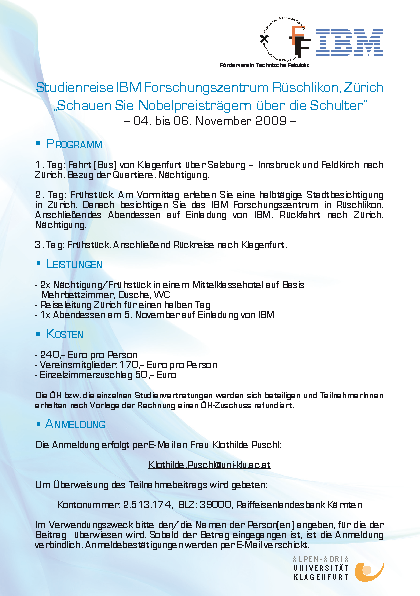 „Schauen Sie Nobelpreisträgern über die Schulter“
Wann: 04. bis 06. November 2009
Wo: Rüschlikon, Zürich, Schweiz
PROGRAMM – PDF
1. Tag: Fahrt (Bus) von Klagenfurt über Salzburg – Innsbruck und Feldkirch nach Zürich. Bezug der Quartiere. Nächtigung.
2. Tag: Frühstück. Am Vormittag erleben Sie eine halbtägige Stadtbesichtigung in Zürich. Danach besichtigen Sie das IBM Forschungszentrum in Rüschlikon. Anschließendes Abendessen auf Einladung von IBM. Rückfahrt nach Zürich. Nächtigung.
3. Tag: Frühstück. Anschließend Rückreise nach Klagenfurt.
LEISTUNGEN
- 2x Nächtigung/Frühstück in einem Mittelklassehotel auf Basis Mehrbettzimmer, Dusche, WC
- Reiseleitung Zürich für einen halben Tag
- 1x Abendessen am 5. November auf Einladung von IBM
KOSTEN
- 240,– Euro pro Person
- Vereinsmitglieder: 170,– Euro pro Person
- Einzelzimmerzuschlag 50,– Euro
Die ÖH bzw. die einzelnen Studienvertretungen werden sich beteiligen und TeilnehmerInnen erhalten nach Vorlage der Rechnung einen ÖH-Zuschuss refundiert.
ANMELDUNG
Die Anmeldung erfolgt per E-Mail an Frau Klothilde Puschl: Klothilde.Puschl@uni-klu.ac.at
Posted in Veranstaltungen Kommentare deaktiviert für Studienreise IBM-Forschungszentrum Rüschlikon, Zürich
Die Erfindung des Zufalls
14. Oktober 2009
Unvoreingenommen meint jeder zu wissen, worum es sich beim Zufall handelt: Etwas, das man nicht prognostizieren kann: ob ich eine gefährliche Operation überleben werde, ob ich beim nächsten Lotto den Haupttreffer landen werde – Dinge dieser Art.
Eigenartigerweise hat der Begriff des Zufalls sogar in exakten Wissenschaften einen fest verankerten Platz erhalten. So zum Beispiel in der Physik. Wenn man ein radioaktives Kohlenstoffatom vor sich hat, kann man auf keine nur denkbare Art und Weise berechnen oder durch Messung bestimmen, zu welcher Zeit es zerfallen wird. Es zerfällt plötzlich irgendwann, ohne dass dafür eine Ursache genannt werden kann – spontan und zufällig. Und in der Biologie hält sich seit Darwin das Paradigma, dass pur zufällige Mutationen die Triebkraft der Entwicklung der Arten nach dem Prinzip der „selection of the fittest“ darstellen.
Allerdings spricht der Naturwissenschafter das Wort Zufall gerne ohne langes Grübeln aus, und es ist auch nicht ganz einfach, eine schlüssige Definition von „Zufall“ anzugeben. Aus der Sicht der Mathematik kann man jedoch den Begriff „Zufall“ einigermaßen gut verstehen: er ist eine Erfindung des Menschen. Um welche Erfindung es sich genau handelt, wird im Vortrag beschrieben.
Posted in TEWI-Kolloquium Kommentare deaktiviert für Die Erfindung des Zufalls
News
14. Oktober 2009
Posted in News Kommentare deaktiviert für News
Tutorial: Teaching Digital Forensics to Undergraduates
13. Oktober 2009
I describe the digital forensics course (one semester) that we teach to year 2 undergraduate students at Deakin University. Along with some details about the students and their response to the course, I outline the two practical assignments they do, and for the second of these use forensic tools to show how data can be hidden in and retrieved from files.
Posted in TEWI-Kolloquium Kommentare deaktiviert für Tutorial: Teaching Digital Forensics to Undergraduates
Efficient Broadcast Key Distribution with Dynamic Revocation
13. Oktober 2009
In many commercial applications of broadcast, it is desirable that only those users who have paid for the service can retrieve broadcast data. Typical examples of such applications are pay-TV and copyright-protected digital materials. To ensure that only those users who have paid for the service can access materials, encryption of the broadcast is implemented. While only privileged users have secret keys to decrypt broadcast programs, malicious users may leak the secret keys to non-privileged users. In order to overcome this problem, secret keys are often kept in tamper-proof smart cards. When a user registers for the system, the service provider issues a smart card which is used for decryption of broadcast programs. In any subscriber scenario, the set of privileged users is dynamically changing and users may unsubscribe from the service at any time. A challenging problem is how to stop them to continue to obtain the broadcast data. This is called the revocation problem.
Although smart cards are intended to be tamper-proof, it may be possible to compromise them. With secret keys extracted from a compromised smart card, a pirate may create many clones of the smart card and sell them. Thus, an additional challenge is how to trace the source of a captured illegally cloned smart card and revoke all cloned cards. This is called the traitor tracing problem. In this work, our goal is to develop an efficient broadcast key distribution scheme, with revocation, which allows only privileged users to get access to the broadcast key. We aim to achieve this efficiently by using smart cards with limited computing power, communication capability, and storage. We assume the existence of a group controller (GC), which plays the role of a trusted third party. The GC broadcasts the encrypted data and key information through separate channels. The broadcast channels are insecure. Each privileged user is equipped with a Set Top Terminal (STT) with no return channel. In general, the STT is composed of a communication device, a tamper-proof decoder and a smart card slot in which a tamper-proof smart card (SC) is placed for key management. We implement polynomials over finite fields to establish efficient broadcast key distribution and efficient revocation.
(Joint paper of Prof. Lynn Batten (Deakin University) and co-author Dr. Xun Yi (Victoria University, Melbourne))